
A customer survey works best when the question fits where the customer is right now in their buying journey.
Ask someone who ordered yesterday what nearly stopped them from buying. They can still tell you. Put the same question to a year-old customer, and you’re asking them to remember a decision from twelve months ago.
Ask at the wrong moment and people still answer, but that reply describes a stage the customer has already moved past.
The 55 customer feedback survey questions below are listed by the right moment in a customer’s lifecycle, from the first visit to years of loyalty. Each one is written to paste straight into a survey, wording and all.
Table of Contents
What Your Analytics Can’t Tell You
Your analytics can tell you that a customer left a page, or put a product back in the cart. It can’t tell you why.
In a report, every abandoned cart looks the same. It could be the shipping cost, a phone call, or a cheaper option elsewhere. Those are three different problems. Asking is the only way to tell which one you have.
An answer is only worth having if the person has something to base it on. A customer who signed up an hour ago hasn’t used the product long enough to say what they’d change about it. Someone still in checkout hasn’t received anything yet, so a recommendation score from them measures your marketing rather than your product.
Both of those surveys come back full of data. Neither is worth acting on.
Recency counts as much as the stage does. A checkout problem described in the same week comes with specifics. The same question months later gets a summary at best.
That also rules out the once-a-month roundup, where every question arrives at the wrong moment for somebody.
A well-timed survey also reads as attention. That goodwill is one of the wider benefits of customer feedback, and it never shows in a report. A long one at a random moment reads as a chore.
What Each Answer Format Is For
Every question below carries a label in square brackets naming the kind of answer to collect. It’s the format that tends to produce a usable answer for that question.
- [Star rating] when you want a score you can compare month to month.
- [Radio buttons] when one answer from a short list is enough.
- [Checkboxes] when more than one answer can be true at the same time.
- [Yes/No] when there really are only two answers. Build it as radio buttons with two options.
- [Short answer] when a word or a phrase will do.
- [Long answer] when you need the person’s own wording.
- [Net Promoter Score] for the recommendation question, which uses a fixed 0-to-10 scale.
The labels sit beside each question rather than in a legend up here. You’ll copy questions straight out of this page, and a question copied without its format loses half the instruction.
If you disagree with a label, change it. Just be careful rating something the person can’t judge yet. That gives you a number that looks like data but isn’t.
Open questions give you detailed answers, and only a few of them. A survey that’s all long answers comes back nearly empty. A scale with no box to explain the score gives you the temperature and none of the reason.
So pair one rated question with one open follow-up. Several groups below are built that way.
For the mechanics of each control rather than advice on timing, our guide to the types of survey questions covers what each one does. For the wording traps that cost you answers, read the survey question types to avoid before you write your own.
55 Customer Feedback Survey Questions, By When You Ask Them
The six moments below run in the order a customer moves through them. Pick the one where you currently have no idea what people think, and start there.
Before You Start
Pick one moment and run it for a few weeks before you add a second. If you can’t choose, start with group 2, right after someone buys. A purchase is a clear event to trigger on, and the customer has just decided you were worth paying.
Six surveys running at once produces six half-answered surveys, and no way to tell which moment the useful answers came from. For the same questions organized by what you want to learn instead of when you ask, our survey question examples covers the other axis.
1. Before They Buy
The questions in this group are for visitors who haven’t bought anything yet, which makes them the hardest group to survey. They’re also the only people who can tell you why someone doesn’t buy, because anyone who already bought is past that hesitation.
Keep it to a few questions here. Someone still deciding hasn’t committed anything yet, and a survey that interrupts the decision can cost you the sale it was meant to explain.
To catch people as they leave rather than while they browse, build it as an exit-intent survey instead. If you only have room for one, you may want to ask the first.
- What is your biggest concern about using something like this? [Long answer]
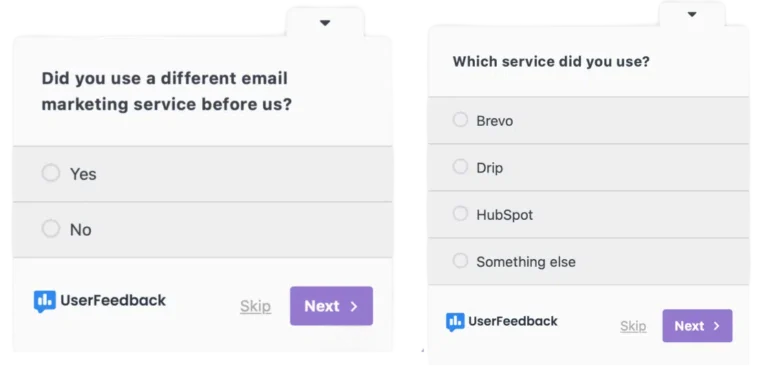
- Have you used a similar product before? [Yes/No]
- What were you using before you found us? [Short answer]
- What did you like about it? [Long answer]
- What made you want to try us instead? [Long answer]
- When you shop, which matters most: the product, the experience, or the price? [Radio buttons]
- Which of these matters most in a company you buy from? [Radio buttons]
- Would you buy [new product] if we offered it? [Yes/No]
- What were you hoping to find that is not on this page? [Long answer]
Question 9 is worth keeping even when the answers are vague. A few replies naming the same missing detail, a size chart or a delivery time, is usually a quick fix.
Say three people mention, in different words, that they weren’t sure it works with something they already own. The fix is a missing sentence above the buy button, and you can add it right away.
Pre-purchase answers tend to be things you can change within the week.
2. Right After They Buy
The window just after a purchase is short, and it works for one reason. The purchase is still the freshest thing in the customer’s mind.
I’d send it within a day or two of the order rather than after delivery, unless the question is about delivery itself.
Price questions also land better here than they do before the purchase. Put one before they buy and you get a negotiating position. Put it just after, and you get an opinion.
- What nearly stopped you from buying? [Long answer]
- Was what you received worth what you paid? [Radio buttons]
- Is our pricing about right? [Radio buttons]
- Based on this order, would you buy from us again? [Yes/No]
- Was this purchase for you or for someone else? [Radio buttons]
- Which of these would you be interested in next? [Checkboxes]
- Was anything about checkout confusing? [Long answer]
- How did the order arrive compared to what you expected? [Radio buttons]
If you keep only one question here, keep question 10. The people answering it are the ones who pushed through the problem rather than leaving, so they can still describe what the problem was.
Watch for a pattern in the replies, often the shipping cost or uncertainty about returns. Whatever comes up most often is your first fix, and it’s usually a change to the product page rather than the product itself.
For a fuller set aimed at this moment, see our post-purchase survey questions.
3. When They Are Still New to It
There’s a gap between buying something and making it part of how you work. That gap is where quiet churn tends to happen.
The first week decides whether the thing becomes a habit, and you rarely hear about it either way. These questions are for that week.
Read these answers together rather than one at a time, and look for the same step coming up again and again.
- What are you hoping to get done with [product]? [Long answer]
- How much experience do you have with tools like this? [Radio buttons]
- What almost stopped you from signing up? [Long answer]
- Was there anything you expected to find and did not? [Long answer]
- How long before this was actually useful to you? [Radio buttons]
Compare the answers to question 18 against what people actually do in the product. Look at which features they open in the first week and which they never touch. Where the two disagree, you’re either helping with the wrong job or explaining the right one badly.
Some people may describe a job you didn’t know you served. That’s more useful than a feature request, because it means your documentation is written for the wrong reader.
Read question 22 again in a few months. If the typical reply moves from days to hours, your onboarding change worked.
4. Once They Have Been Using It
Established customers can answer in detail, and there’s little urgency attached to the asking. That makes this the one moment where a longer survey is reasonable, four or five questions for someone who has been a customer for months.
Answers from this group tend to be concrete, because the person has real experience to draw on rather than an expectation. You can act on their feature requests.
- How happy are you with the range we offer? [Star rating]
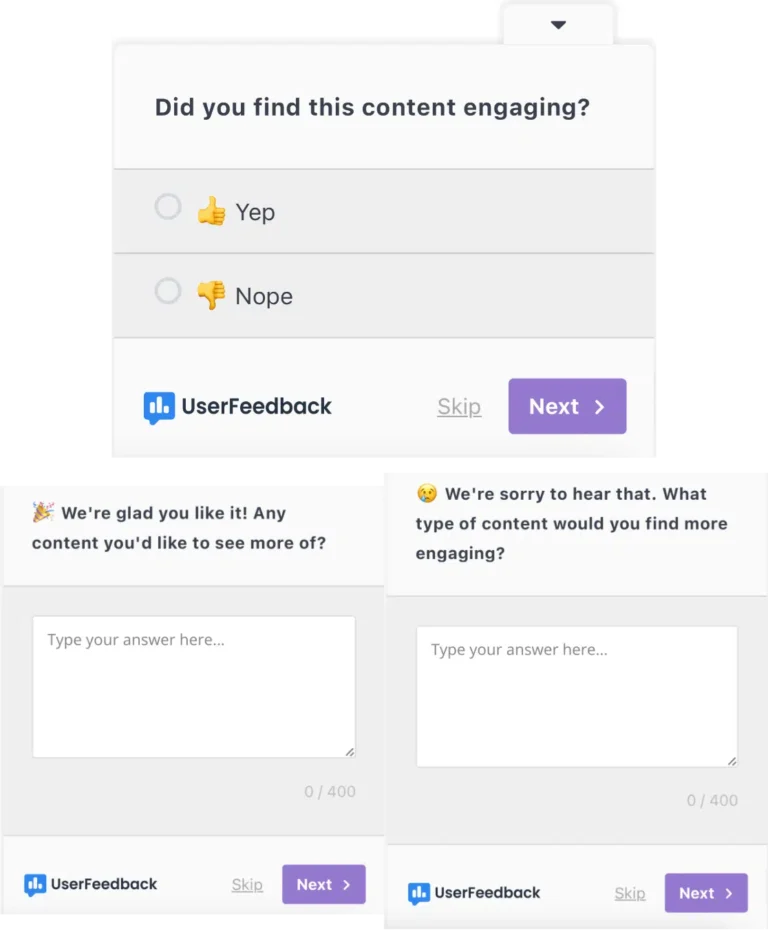
- Was this [feature/article/product] useful to you? [Yes/No]
- What is one feature you would like to see? [Long answer]
- Which of these words would you use to describe it? [Checkboxes]
- How would you rate the [design/quality/fit]? [Star rating]
- How do you use [product] day to day? [Long answer]
- What is your favorite thing about it? [Long answer]
- What is the one thing you would change? [Long answer]
- Is there anything you tried and stopped using? [Long answer]
- Which part do you use least? [Radio buttons]
Keep two lists as the answers arrive. The first holds every feature people say they use constantly, including the ones you think of as minor, and that’s your do-not-break list.
The second holds anything nobody mentions, including the feature you’re proudest of. Something missing from every reply is either hard to find or less useful than you thought, and a follow-up question will tell you which.
If you’ve never asked what people stopped using, add questions 31 and 32. Feature requests capture what people think they want; what they quietly abandoned is what actually failed.
For a survey built around one product rather than a general set of questions, see how to make a product feedback survey.
5. Right After They Contact You
Someone who has just finished a conversation with you, over chat or email, has a sharp opinion that fades within hours. It’s also an easy moment to miss entirely.
Keep this one short, just a couple of questions. A long survey at the end of a resolved problem undoes the goodwill the conversation earned.
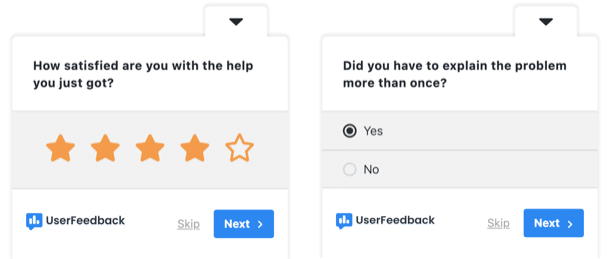
- How satisfied are you with the help you just got? [Star rating]
- What could we have done better? [Long answer]
- How easy was it to get this resolved? [Star rating]
- Did you get the answer you needed? [Yes/No]
- Was our returns policy fair? [Yes/No]
- Was it easy to find how to reach us? [Yes/No]
- What would have made it easier to get help? [Long answer]
- Was your question answered in one conversation? [Yes/No]
- Did you have to explain the problem more than once? [Yes/No]
- Was the wait about what you expected? [Radio buttons]
- Would you rather have handled this another way? [Radio buttons]
- What would have saved you getting in touch at all? [Long answer]
Read questions 40 and 41 together. Your team can’t see from the inside whether something was resolved in one conversation, or whether the person had to repeat themselves. Both are fixable once you know.
Then watch for the people who had to explain the problem twice and still rated the help highly. That pair of answers says your team is good and your handoffs aren’t.
These questions are about the conversation itself. For a support team’s performance more broadly, our customer service survey questions covers that ground.
6. Once They Have Been With You a While
Long-standing customers can tell you what you’re actually like to deal with. They’ve used you long enough to weigh the promise against the reality, and they’re the group easiest to forget to ask.
This is where the recommendation question belongs. I’d hold it until someone has been with you a year or so. Asked earlier, it measures your marketing rather than the product.
- How likely are you to recommend us to someone else? [Net Promoter Score]
- How long have you been with us? [Radio buttons]
- How would you describe us in three words? [Short answer]
- What would you tell a colleague about us? [Long answer]
- Has anything about working with us surprised you? [Long answer]
- What difference has it made to you? [Long answer]
- How would you describe your experience in one sentence? [Short answer]
- Do you try free trials or discount codes before committing? [Yes/No]
- Do you prefer things quick and simple or detailed and configurable? [Radio buttons]
- Who do you know who would get the most out of this? [Long answer]
- Have you recommended us to anyone already? [Yes/No]
Run questions 54 and 55 together. The first describes who your happiest customers think you’re for. The second is a rough measure of the word of mouth you already have.
Read the three-word answers to question 47 for words you wouldn’t have chosen yourself, then try them in your own copy. Question 51 gives you full sentences you can quote, with permission, instead of writing them from scratch.
You can also turn the recommendation question into a number you track. Our guide on how to calculate an NPS score covers the arithmetic and what counts as a good result.
Choosing the Moment: A Quick Reference
If you aren’t sure where to start, work backward from the thing you can’t currently explain.
- You don’t know why people leave without buying. Start with group 1, on the pages where they leave.
- Orders are fine but nobody comes back. Group 2, within a day or two of the order.
- People sign up and go quiet. Group 3, in the first week.
- You’ve a roadmap and no evidence behind it. Group 4, to customers of a few months or more.
- Support feels busy and you can’t tell if it’s working. Group 5, at the end of each conversation.
- You want to know whether people would recommend you. Group 6, to anyone past their first year or so.
Run one for a few weeks before judging it, and longer if the moment is rare. A support survey on a busy site collects enough answers quickly; a pre-purchase survey on a quiet product page takes considerably longer. Stopping early, on a handful of replies, is what makes a survey look like it doesn’t work.
Keep any single survey to a length someone could finish while standing up.
If nobody is answering at all, the question isn’t your problem. Start with our twelve ways to increase your survey response rate instead of a different question list.
And when the answers do start arriving, the work shifts from asking to reading. Our guide to customer feedback analysis covers what to do with a few hundred open-text replies.
How to Ask These Questions on a WordPress Site
Every question above assumes you can put a survey in front of the right person at the right moment, which is the difficult part.
On a WordPress site it needs three things: a way to build the question, a way to choose who sees it, and somewhere for the answers to collect that isn’t your inbox.
UserFeedback handles all three from inside WordPress. You build the question in the dashboard and choose one of its question types for the answer.
Choosing which pages a survey appears on is what gets each group in front of the right person. A survey aimed at people who haven’t bought anything belongs on your product pages; one aimed at long-standing customers doesn’t. Page-level targeting is available on Plus and above.
Some answer formats and some of the appearance options are also on paid plans. Check the current pricing page before you build anything that depends on a specific option.
Know why your visitors do what they do
UserFeedback builds these questions into your WordPress site and collects the replies for you. You get to read what visitors actually wrote, instead of working it out from a traffic report.
If you would rather see complete surveys before writing your own, our collection of online survey examples lays out finished surveys by type.
For anything focused on satisfaction scoring, start with our satisfaction survey examples.
FAQs About Customer Feedback Surveys
What are the best customer feedback survey questions to ask?
The best question is the one that matches the moment you’re asking in. A new buyer can tell you what nearly stopped them. A long-standing customer can tell you whether they’d recommend you. Neither question works in the other’s moment.
When is the best time to send a customer feedback survey?
As close to the event as you can manage. Post-purchase questions work within a day or two of the order, and questions about a support conversation belong at the end of it. Questions about a product need a few weeks of use behind them.
Should I ask the same questions at every stage?
No, with one exception. Most questions only make sense at one point, and asking them elsewhere gets you a made-up answer rather than a real one. The exception is the recommendation question: ask the same people over time, because the change in their answer tells you more than any single reading.
Can I cover more than one stage in a single survey?
You can, but it’s usually a mistake. Put checkout and a support conversation in the same survey and most respondents can only speak to one. You can’t tell the two apart. Two short surveys at two moments give you cleaner answers than one long survey at a random moment.
Do I need different questions for a service business than for an online store?
The moments are the same; only the nouns change. A store asks about delivery and returns where a service business asks about onboarding and turnaround. But both have the same three points: just after someone commits, when the thing is new, and once the person can finally judge it.
What should I do with the answers once I have them?
Read the open-text replies before you look at any averages. The scores show whether something changed; only the sentences say what to change. Group the replies by the problem they describe, then act on whatever the largest group raises, even when its score looks fine.
That’s it! I hope this article helped you find the right customer survey questions to ask, and the right moment to ask them. If you liked this article, check out the following resources:
- 45+ Survey Question Examples People Actually Answer
- 28 Great Customer Service Survey Question Examples
- Bad Survey Questions: 8 Types to Avoid (+ How to Fix Them)
- 12 Proven Ways to Increase Your Survey Response Rate
- Demographic Survey Questions: Complete Guide with 15 Examples
- Tutorial: Net Promoter Score® (NPS®) Survey in WordPress
And remember to follow us on X and Facebook to learn more about online surveys, questions, and customer feedback.